High-Recovery Fryers: What Actually Defines Throughput
Oil capacity is a storage figure. Recovery time is the throughput figure. Here is how vat geometry, heat input, and filtration decide how many orders your fry station can actually turn out.
Editorial note: This is researched buying guidance, not a hands-on product review. No product named or linked here has been tested, owned, or endorsed by us unless explicitly stated. No prices, ratings, or availability are quoted. Read how we research.
Fryer spec sheets lead with capacity, because capacity is easy to print and easy to compare. In service, capacity tells you almost nothing about output. The number that decides whether your fries go out crisp at seven o'clock on a Friday is recovery time.
This article explains what recovery means, why vat geometry changes it, and how to size a fry station from your peak ticket instead of from a brochure.
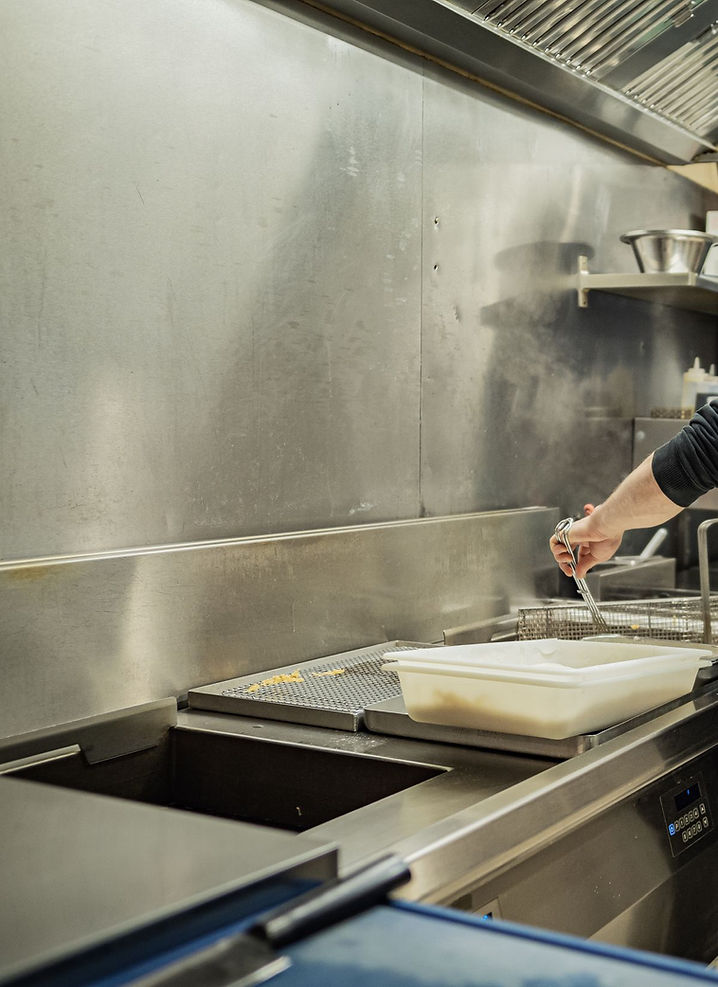
Photograph
The fry station under a working extraction hood, baskets in rotation. Licensed stock photograph, not our kitchen, and not a specific model.
Photo: Stefan de Vries / Pexels License
Recovery, not oil capacity, defines throughput
A fryer's advertised capacity is how much oil the vat holds. Recovery is how quickly the oil returns to setpoint after a load of cold or frozen product pulls the temperature down. In a working kitchen the oil is almost never sitting at setpoint, so the recovery figure is the one that governs output.
The practical consequence: a smaller vat that recovers quickly can out-serve a large vat that recovers slowly. Two well-designed 40 pound vats in rotation will beat one 70 pound vat when orders arrive continuously, because each vat spends less time below temperature.
If your product goes pale and greasy at peak rather than at open, that is usually a recovery problem, not a recipe problem. Ask for documented recovery or heat-up data rather than a capacity figure, and treat a spec sheet that only lists oil volume as an incomplete answer.
Vat geometry: tube, flat-bottom, and open pot
Tube-type gas fryers fire burners through tubes submerged in the oil. That design leaves a large cooler zone at the bottom where crumbs settle away from the heat source, which extends oil life and reduces off-flavors in the next batch. Heat-up is slower, and the units are heavy and robust. They are the standard in high-volume kitchens for good reasons.
Flat-bottom gas fryers use shallow oil depth over a heated bottom. They heat and recover faster, drain and clean more easily, and take less oil. The trade-off is that sediment sits close to the heat, so filtration discipline matters much more and skipped filtering shows up quickly in oil color.
Open-pot designs, common in cheap countertop units, put a burner under a thin vat. Heat is uneven, sediment scorches, and the oil degrades fast. That is acceptable for occasional low volume and a false economy anywhere the fryer runs a real service.
Match geometry to the menu: heavy breading and high starch volume reward a large cold zone, while delicate items and short cycles reward fast recovery.
Gas or electric, and what the heat actually costs
Gas fryers fire on demand and recover quickly. They also need a gas supply, a flue, and hood and suppression arrangements per code, which adds install cost and an inspection dependency.
Electric fryers convert energy to oil heat efficiently and place easily without gas plumbing, and they put less combustion product into the air. They typically recover more slowly than gas, and they add a substantial load to your electrical service.
Running cost is a local question. Propane, natural gas, and electricity diverge widely by market, so model annual energy and oil together rather than trusting a generic comparison. At volume, oil consumption usually matters more than the energy line.
Two smaller fryers also give you redundancy. A single large unit that goes down takes the whole fried section off the menu for the length of a service call.
Filtration is the operating cost you control
Oil dies from crumbs, water, and sustained heat. A built-in filter pump, or a filter cycle on a drain valve, lets the crew clean oil during service, which measurably extends oil life and keeps product consistent. Portable filter carts cost less up front and more in labor and floor space.
Decide who filters, how often, and where the waste oil goes before you buy. The best fryer available degrades into an average one if nobody filters it, and a fry station that produces poor product is expensive no matter what it cost.
This is also a safety point: filtering hot oil is one of the most common burns in a commercial kitchen. The workflow you plan around the fryer matters as much as the fryer.
Sizing to peak orders per hour
Work from the ticket, not from the cover count. Take your peak orders per hour, multiply by the portion of those orders that include a fried item, and divide by the baskets you can run per cycle. A peak hour of 60 fried orders on three minute cycles needs two baskets in continuous rotation before you account for refires and the double order.
Then add headroom, roughly twenty percent, because a fry station at one hundred percent utilization has no answer for a table that orders three baskets at once.
Separate vats matter for more than volume. Fish and shellfish in one vat and fries in another is often an allergen and cross-contact requirement rather than a preference, and a twin-vat configuration lets you satisfy it without two separate appliances.
Code, safety, and installation realities
Budget for the hood, the suppression system, a gas shutoff within reach, the clearances to combustibles stated in the manual, and a legitimate path for waste oil. None of those are optional, and all of them affect where the unit can physically go.
Confirm the unit carries the sanitation listing your inspector expects, and ask whether a caster and lock arrangement is required in your jurisdiction. A fryer that fails inspection on placement is a fryer you cannot open with.
Finally, plan the drain and filter workflow before the equipment lands. Fryer problems are usually plumbing, filtration, or ventilation problems wearing a cooking problem as a disguise.
Compare by type, not by brand
These categories describe how each design behaves in service. They are deliberately not a product ranking: no model, price, or rating is listed because none has been verified.
Tube-type gas
- Best for
- High-volume starch and breaded product
- Recovery
- Moderate heat-up, strong sustained output
- Utilities
- Gas, flue, hood and suppression
- Watch-outs
- Heavy; longer heat-up; larger footprint
Flat-bottom gas
- Best for
- Busy lines with disciplined filtering
- Recovery
- Fast heat-up and recovery
- Utilities
- Gas, flue, hood and suppression
- Watch-outs
- Sediment close to heat; oil dies faster without filtering
Electric countertop
- Best for
- Small kitchens, light fried volume
- Recovery
- Slowest recovery; steady heat
- Utilities
- Heavy electrical load, easier ventilation
- Watch-outs
- Adds to service capacity; limited batch size
Twin-vat gas
- Best for
- Menu separation and allergen control
- Recovery
- Good per vat; flexible rotation
- Utilities
- Gas, flue, larger hood
- Watch-outs
- Two vats to filter and clean, less capacity per vat
| Type | Best for | Recovery | Utilities | Watch-outs |
|---|---|---|---|---|
| Tube-type gas | High-volume starch and breaded product | Moderate heat-up, strong sustained output | Gas, flue, hood and suppression | Heavy; longer heat-up; larger footprint |
| Flat-bottom gas | Busy lines with disciplined filtering | Fast heat-up and recovery | Gas, flue, hood and suppression | Sediment close to heat; oil dies faster without filtering |
| Electric countertop | Small kitchens, light fried volume | Slowest recovery; steady heat | Heavy electrical load, easier ventilation | Adds to service capacity; limited batch size |
| Twin-vat gas | Menu separation and allergen control | Good per vat; flexible rotation | Gas, flue, larger hood | Two vats to filter and clean, less capacity per vat |
Fryer types compared by recovery behavior and service role, not by brand. Type-level comparison, no brands or prices.
The pre-purchase checklist
- Recovery or heat-up data requested in writing, not just oil capacity.
- Peak fried orders per hour calculated, with about twenty percent headroom.
- Vat separation planned if fish, shellfish, or allergens are on the menu.
- Electrical load or gas supply confirmed at the site before ordering.
- Filtering method chosen, with a named person and a daily frequency.
- Hood, suppression, and clearance requirements checked against local code.
- Waste oil disposal route established before the first fry.
- Replacement parts available for thermostats, valves, and baskets.
Where to buy
These slots are reserved for the equipment types above. A button appears only after a validated affiliate link has been entered for that slot, so a pending slot means no link has been approved yet, not that the item is unavailable.
Commercial fryer
Slot: Commercial fryer
Filtration and fryer accessories
Slot: Fryer filter and accessories
Affiliate disclosure: As an Amazon Associate I earn from qualifying purchases. Buttons open the product on Amazon in a new tab. No specific product is recommended by name in this article, and no price, rating, or availability is shown. See how we research.
Get the next guide
One tool to buy, one to bury, every Tuesday.

