Best Countertop Griddles for Food Trucks and Small Kitchens
Plate thickness, recovery under load, and generator math decide whether a countertop griddle works in a hundred square feet. Here is how to spec one without overpaying or underpowering.
Editorial note: This is researched buying guidance, not a hands-on product review. No product named or linked here has been tested, owned, or endorsed by us unless explicitly stated. No prices, ratings, or availability are quoted. Read how we research.
A countertop griddle is the cheapest way to buy real cooking output per square foot. It does one job extremely well: continuous, flat, high-output cooking on a single surface. Eggs, pancakes, burgers, tortillas, onions, and vegetables can all come off the same plate in sequence, which matters when your menu shifts through the day.
This article covers the specification logic, not a product ranking. It explains what the numbers on a spec sheet actually do in service, which choices are reversible, and where a cheap unit becomes expensive.
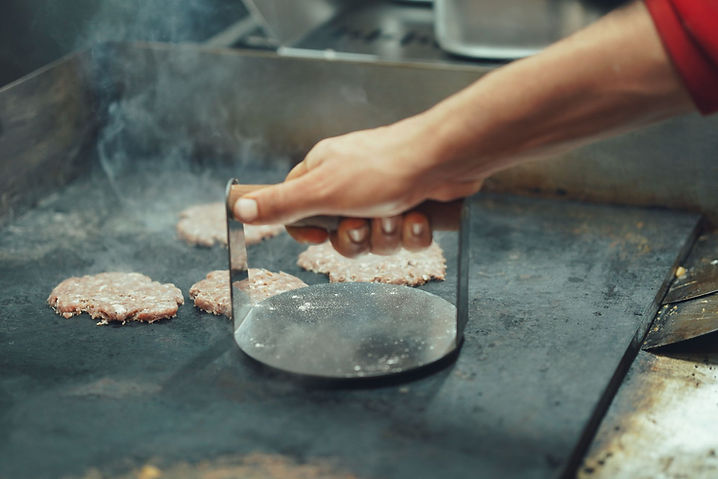
Photograph
A flat top worked at volume: patties pressed down, the surface fully loaded. Licensed stock photograph, not our kitchen, and not a specific model.
Photo: Reza Tavakoli / Pexels License
Why a griddle beats a range in a small kitchen
Compared with open burners, a griddle gives you more usable cooking area per dollar and per square foot, and it throws off far less airborne grease. That second point is not cosmetic: less grease in the air means an easier hood requirement and a kitchen or truck interior that stays less tacky, which reduces cleaning labor at the end of every shift.
What you give up is zone control on a single plate, oven capacity, and the ability to use a pan for a sauce or a reduction. Most small operators pair one griddle with one or two burners, rather than expecting a griddle to be the whole hot line.
The most common specification error is buying a unit described as 'commercial style' that is really a home appliance behind a stainless front. It looks correct and fails in the first real service, because the plate is too thin to hold heat and the controls were never designed to be cycled all day.
Plate thickness is the spec that decides throughput
A griddle stores heat in steel. When you land cold or frozen product on the plate, surface temperature drops and has to climb back. A thicker plate holds more stored heat, so the drop is smaller and recovery is faster. Commercial countertop plates generally run from about three quarters of an inch to an inch; home-duty plates are thinner.
Ask for plate thickness in writing before you order. If a listing will not state it, treat that omission as the answer, because it is the first thing a serious equipment dealer will tell you.
Control type matters as much as thickness. A manual gas valve holds a valve position, so an empty griddle overheats and a loaded one undercooks. Thermostatic control cycles the burner to hold a setpoint, which is what you need when the crew changes product repeatedly through service. Thermostatic units cost more and add a probe that can fail, so check that the probe is a stocked part rather than a special order.
Zone control is the other lever. Two independent thermostats across a 36 or 48 inch plate let one zone run at searing heat while another holds egg temperature. For brunch service that is the difference between a workable line and a queue at the pass.
Electric or gas: your generator decides first
On shore power, or in a permanent small kitchen, electric is usually the simpler installation. There is no gas line, no flue, and less heat dumped into the room, and ventilation requirements are easier to meet. The trade-off is electrical capacity, and this is where trucks fail.
Do the arithmetic before you shop. A 240 volt unit rated at 6 kW draws about 25 amps; the same element on a 208 volt supply delivers less power and heats more slowly. Confirm the voltage actually available at your site, then compare the unit's draw against your breaker size and your generator's continuous rating, not its surge rating.
Gas countertop griddles fire harder on startup and recovery and often cost less to run where propane is cheap. They also need a regulated supply, a flue, and usually a hood and suppression system above them, which in a truck means plumbing, weight, and another inspection item.
The practical order of operations is: write the power budget first, then choose the fuel that fits it. Buying the griddle and discovering the generator cannot carry it is the expensive sequence, and it is the one most first-time builds follow.
Surface: polished steel or chrome
Polished steel is the default for good reasons. It is durable, it takes a seasoning, it tolerates a scraper and a metal spatula, and it can be resurfaced after years of use. Once seasoned it releases food predictably and it forgives a busy crew.
Chrome-plated plates conduct heat faster, release delicate items such as eggs and fish more cleanly, and run with less radiant heat hitting the product. They are also far less forgiving. A gouge through the plating ruins the surface, metal tools and certain cleaning chemicals have to be controlled, and the plate cannot be resurfaced the way steel can.
Choose chrome only if delicate proteins are central to your menu and the crew will respect it. For a two-cook truck with a scraper and a rush, polished steel is the safer investment.
Grease handling, clearance, and cleanup
Front-trough units are easier to scrape directly into during service when the griddle sits against a wall. Rear-trough units keep the working edge clear but force the cook around the side. Neither is better in the abstract; which one works depends on where the unit sits and which hand the cook scrapes with.
Grease drawer capacity decides how often someone has to break rhythm to empty it. A small drawer on a high-volume day fills quickly, and a griddle with no drawer puts grease on the floor, which is both a slip risk and an inspection finding.
Splash guards on the ends keep grease off adjacent equipment and off the wall. Clearances to combustibles are stated in the manual and enforced by your inspector: a griddle pushed tight against a wooden counter is a fire risk and a failed inspection, not a clever use of space.
Sizing to the peak ticket, not the floor plan
Common widths are 24, 36, 48, and 60 inches. More width means more surface and, on a well-built unit, more heat under a larger plate. But one large single-zone plate can be worse than two smaller independent plates, because a single zone cannot hold two temperatures at once.
Two 24 inch units let you run separate temperatures, keep serving while one is cleaned down, and replace half your capacity if one fails. The cost is more hood length, more connections, and more surfaces to clean. In a very small kitchen, that trade can go either way.
Size to the busiest half hour of your week, then confirm the hood can capture what the griddle produces. Remember that a griddle is usually the largest radiant heat source in a small kitchen, and that heat lands on your refrigeration and on your crew.
Compare by type, not by brand
These categories describe how each design behaves in service. They are deliberately not a product ranking: no model, price, or rating is listed because none has been verified.
Manual steel, 3/4 in
- Best for
- High-volume single-temperature work: burgers, breakfast
- Recovery under load
- Slower under repeated loads; valve stays where it was set
- Utilities
- Gas or electric, simple install
- Watch-outs
- No setpoint control; runs hot when empty
Thermostatic steel, 1 in
- Best for
- Mixed menus and changing product through service
- Recovery under load
- Faster; holds setpoint as load changes
- Utilities
- Gas or electric; needs probe service
- Watch-outs
- Thermostat probe is the wear item
Chrome-plated
- Best for
- Delicate proteins, eggs, lower radiant heat
- Recovery under load
- Fast heat transfer to the surface
- Utilities
- Gas or electric
- Watch-outs
- Plating damage is permanent; cleaning discipline required
Dual-zone 36 to 48 in
- Best for
- Brunch and multi-temperature service
- Recovery under load
- Good per zone, limited per zone area
- Utilities
- Higher connected load, longer hood
- Watch-outs
- More controls and seams to clean
Countertop plancha or induction
- Best for
- Very small footprints, single-item speed
- Recovery under load
- Fast per item, little stored plate heat
- Utilities
- Electric only; tight breaker budget
- Watch-outs
- Not a substitute for flat-surface volume
| Type | Best for | Recovery under load | Utilities | Watch-outs |
|---|---|---|---|---|
| Manual steel, 3/4 in | High-volume single-temperature work: burgers, breakfast | Slower under repeated loads; valve stays where it was set | Gas or electric, simple install | No setpoint control; runs hot when empty |
| Thermostatic steel, 1 in | Mixed menus and changing product through service | Faster; holds setpoint as load changes | Gas or electric; needs probe service | Thermostat probe is the wear item |
| Chrome-plated | Delicate proteins, eggs, lower radiant heat | Fast heat transfer to the surface | Gas or electric | Plating damage is permanent; cleaning discipline required |
| Dual-zone 36 to 48 in | Brunch and multi-temperature service | Good per zone, limited per zone area | Higher connected load, longer hood | More controls and seams to clean |
| Countertop plancha or induction | Very small footprints, single-item speed | Fast per item, little stored plate heat | Electric only; tight breaker budget | Not a substitute for flat-surface volume |
Countertop griddle types compared by specification, not by brand. Type-level comparison, no brands or prices.
The pre-purchase checklist
- Plate thickness stated in writing, at three quarters of an inch or more.
- Voltage at the site confirmed, and draw compared with breaker and generator continuous rating.
- Thermostatic control if the menu changes product through service.
- Two zones if you will ever run two temperatures at once.
- Grease drawer large enough for your busiest shift, with a scraper you can reach.
- Hood and clearance requirements checked against the manual and your local code.
- Replacement parts available for thermostats, elements, and burners before you buy.
- Casters or a leveling arrangement that suits a moving truck or a fixed line.
Where to buy
These slots are reserved for the equipment types above. A button appears only after a validated affiliate link has been entered for that slot, so a pending slot means no link has been approved yet, not that the item is unavailable.
Countertop griddle, steel plate
Slot: Countertop griddle
Griddle sized for a truck build
Slot: Food truck griddle
Affiliate disclosure: As an Amazon Associate I earn from qualifying purchases. Buttons open the product on Amazon in a new tab. No specific product is recommended by name in this article, and no price, rating, or availability is shown. See how we research.
Get the next guide
One tool to buy, one to bury, every Tuesday.

